Last updated: 26 August 2026
In short
If you need the exam for a C permit or Swiss citizenship, SDS and fide are the obvious candidates. Both certify oral and written German separately, and both are built around everyday life in Switzerland. For most of my clients, SDS turns out to be the better fit. One reason is that the results arrive within a few days. telc and Goethe are the international route. The differences become clearer once you look at the format, the speaking exam, waiting times and cost.
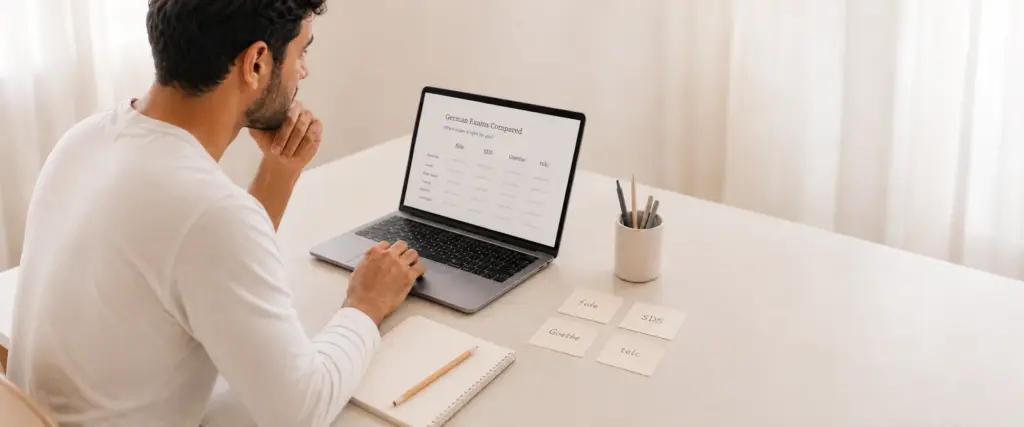
This article compares all four on the points that matter in practice: levels, the speaking exam, Swiss content, preparation, availability, waiting time and cost.
If you need a German exam in Switzerland for a C permit (Niederlassungsbewilligung) or citizenship (Einbürgerung), you will probably come across SDS, fide, telc and Goethe.
All four are recognised options. Which one makes sense for you depends on the level you need, how the exam works and how you want to prepare.
Before booking anything, check the exact requirement for your situation: which spoken level do you need, and which written level? See what German level you need for Swiss citizenship and what German level you need for a C permit.
Start with the level you need
This can already narrow down your options quite a bit.
SDS covers A1 to B2. You do not register for a specific level. The test is adaptive, so the tasks change according to your performance and you receive the level you actually reach. Your spoken and written results can be different.
The fide-Test covers A1 to B1. It also assesses your spoken and written German separately rather than giving you one overall level for everything.
telc and Goethe. With telc and Goethe, you normally choose your target level before the exam. If you book B1, you prepare for a B1 exam across reading, listening, writing and speaking.
Imagine you need B1 spoken and A2 written. With SDS or fide, you can receive exactly that combination in one test. With telc or Goethe, you would normally prepare for B1 tasks across the whole exam, including writing.
Some cantons require B2 spoken German for ordinary naturalisation. Zug currently asks for B2 spoken and B1 written, Solothurn for B2 spoken and A2 written. The fide-Test stops at B1. SDS reaches B2, as do the recognised telc B2 and Goethe B2 exams.
Are all four recognised in Switzerland?
Yes. SDS, fide, the listed telc exams and Goethe certificates all appear on the official SEM list of recognised language certificates for immigration and citizenship procedures. The current list is dated 1 July 2026, and SEM updates it every three months.
You may notice something on that list. SDS and fide are marked as provisionally recognised, because they are still completing the ALTE quality process. Both have committed to meeting those standards by the end of 2029, and SEM reviews their progress in the meantime. That sounds more dramatic than it is. Both are fully recognised right now and can be used for your application in the normal way.
If you already hold an older German certificate, check the list before booking anything. It may already be enough.
What happens in the speaking exam?
Here the exams start to feel quite different.
| Exam | Who do you speak with? | Typical tasks |
|---|---|---|
| SDS | Examiner | Personal questions, describing, explaining, giving reasons and opinions about related topics |
| fide | Examiner | Everyday situations, simulated phone call, experiences and opinions |
| telc B1 | Usually another candidate | Talk about a topic, exchange opinions, plan something together |
| Goethe B1 | Usually another candidate | Plan something together, short presentation, questions and reactions |
With SDS, the speaking part is an individual interview. Depending on the level, you answer questions about yourself, describe something, explain your ideas or give an opinion.
The fide-Test is also individual. At A2, for example, one task is a simulated telephone call where you may need to arrange, change or cancel an appointment. Other tasks ask you to talk about everyday situations and experiences. At B1, you may discuss an experience, a process, positive and negative sides of something, or a hypothetical situation.
telc B1 is normally a pair exam. You talk about a topic and exchange opinions and experiences. The final part is a planning task that you solve together.
In Goethe B1, you normally also have another candidate with you. First you plan something together. Then you each give a short presentation and respond to questions and comments.
With telc and Goethe, there is usually another candidate in the room. That may suit you perfectly. Or it may be one more person you had not planned on understanding under exam conditions.
How Swiss is the exam?
SDS and fide were both developed around language use in Switzerland.
Both are built on the fide Handlungsfelder. These are the eleven areas of daily life in Switzerland that a national needs analysis identified as the ones people actually have to manage in German: housing, children, work, job search, authorities, media and leisure, transport, shopping, post and banking and insurance, health, and further education.
In the SDS listening part, you hear Swiss Standard German. That is standard German as spoken in Switzerland, with the Swiss accent and Swiss vocabulary. It is not Swiss German dialect.
fide also works with Swiss everyday situations and Swiss language use. The official fide information specifically refers to examples, vocabulary and expressions used in Switzerland.
telc and Goethe are international exam systems. Their certificates are used far beyond Switzerland, which can be useful if you want the qualification for another purpose later.
For someone who already lives here, topics such as housing, appointments, work or dealing with everyday services may simply feel familiar.
How targeted can you prepare?
All four exams have a defined format, so you can prepare for them.
For SDS, the preparation can be very focused. The exact questions change, but the task types are quite structured. You repeatedly need similar language skills: talking about yourself, describing something, giving reasons or expressing an opinion.
That is something I see in my own exam preparation work. Once you know how to build a longer answer, connect your ideas and give a reason, you can use those same tools across many different topics.
fide also stays close to recurring everyday situations, although tasks such as the simulated telephone call require you to react to a specific scenario.
With telc and Goethe, there is more interaction with another candidate. At B1, this can mean discussing a topic, responding to another opinion, planning something together or giving a presentation.
How quickly can you get a test date?
SDS is offered by licensed test centres across German-speaking Switzerland. There are several dates per month, including evening and Saturday options. Depending on the centre, short-notice bookings may also be possible.
I once had a client who decided the day before to take the SDS and found a place. I would not plan around that, but it shows how flexible the booking can sometimes be. SDS could therefore be a good option if you prefer to keep things spontaneous.
fide is widely available as well, with more than 100 accredited test institutions. Officially, you should register at least 15 days before the test date, and many institutions set a longer deadline.
telc and Goethe work with exam dates set by the individual test centres. Registration usually closes several weeks before the exam, in some cases up to six. Availability depends on where you live and which level you need.
If timing matters to you, it is worth checking actual test dates before deciding which exam to prepare for.
How long do you wait for the result?
| Exam | Result time |
|---|---|
| SDS | Usually 2 to 3 working days |
| fide-Test | Around 4 weeks |
| telc | Around 4 to 6 weeks |
| Goethe | Depends on the test centre, usually within a few weeks |
SDS is clearly the fastest here. Three days of wondering how it went is manageable. Four weeks is a different kind of patience.
What do the exams cost?
| Exam | Complete test | Single part or module |
|---|---|---|
| SDS | CHF 239 | CHF 150 (spoken or written) |
| fide-Test | CHF 250 | CHF 170 spoken, CHF 120 written |
| telc | Around CHF 260 at B1 | Around CHF 175 (spoken or written) |
| Goethe | CHF 280 to 290 at B1 | CHF 130 to 160 per module |
SDS and fide charge the same fee at every level. For telc and Goethe, the test centre sets or influences the price and higher levels cost more, so check the current fee with your centre before booking.
So which German exam in Switzerland makes sense for you?
SDS is worth looking at first if your main goal is a C permit or citizenship application. It works particularly well when your required spoken and written levels are different. You take the speaking exam alone, the content is based on life in Switzerland, dates are frequent and the result arrives within days.
If SDS looks like the right option, my complete SDS guide explains the format, modules, costs and what to expect on test day.
fide is a good option if you need up to B1 and want an individual exam based closely on everyday life in Switzerland. Its format is very Swiss, although you should be comfortable reacting to role-play situations such as a phone call.
telc or Goethe may suit you better if you also want an internationally used certificate, already know the format, or are preparing for one of these exams in a course.
For most people I prepare specifically for a Swiss permit or citizenship application, SDS ends up being the most straightforward fit.
Next step
Still unsure which exam fits your situation? Send me your required levels and your timeline, and I can help you narrow down the options.
Get in touchFrequently asked questions
Can my spoken and written level be different in the same exam?
Yes, with SDS and fide. Both certify speaking and writing separately. telc and Goethe issue one level for the whole exam.
Do I speak alone with the examiner?
With SDS and fide, yes. telc and Goethe normally pair you with another candidate for the speaking part.
Can I have a B2 course or another diploma validated instead of taking an exam?
In some cases, yes, through the fide-Dossier. It is open to people who hold a certificate at B1 or higher that is not on the SEM list, who completed a German course at B2, C1 or C2 with a course confirmation, or who have other evidence such as further education in German. Your documents are reviewed and you then attend a validation meeting where your spoken and written German are assessed. The procedure costs CHF 150 and results in a language passport at B1. Two things to know: diplomas are never converted automatically, you have to go through the whole procedure, and the outcome is always B1, never higher.
Is SDS accepted for Swiss citizenship in every canton?
SDS is on the SEM list nationwide. The level required, and any additional cantonal rules, depend on your canton or commune, so confirm with your local authority before booking.
Sources
- State Secretariat for Migration (SEM), List of recognised language certificates, edition 1 July 2026. Checked 26 August 2026.
- Schweizerischer Digitaler Sprachtest, Testhandbuch (6 October 2023) and official SDS test information. Checked 26 August 2026.
- fide, fide-Test and fide-Dossier information, fide-service.ch and fide-admin.ch. Checked 26 August 2026.
- fide, Handlungsfelder, fide-info.ch. Checked 26 August 2026.
- telc, telc Deutsch B1 examination information and Swiss centre fee schedules. Checked 26 August 2026.
- Goethe-Institut, Goethe-Zertifikat B1 examination information, Swiss registration portal and ZHAW ILC. Checked 26 August 2026.
- Kanton Zug and Kanton Solothurn, current language requirements for ordinary naturalisation. Checked 26 August 2026.